
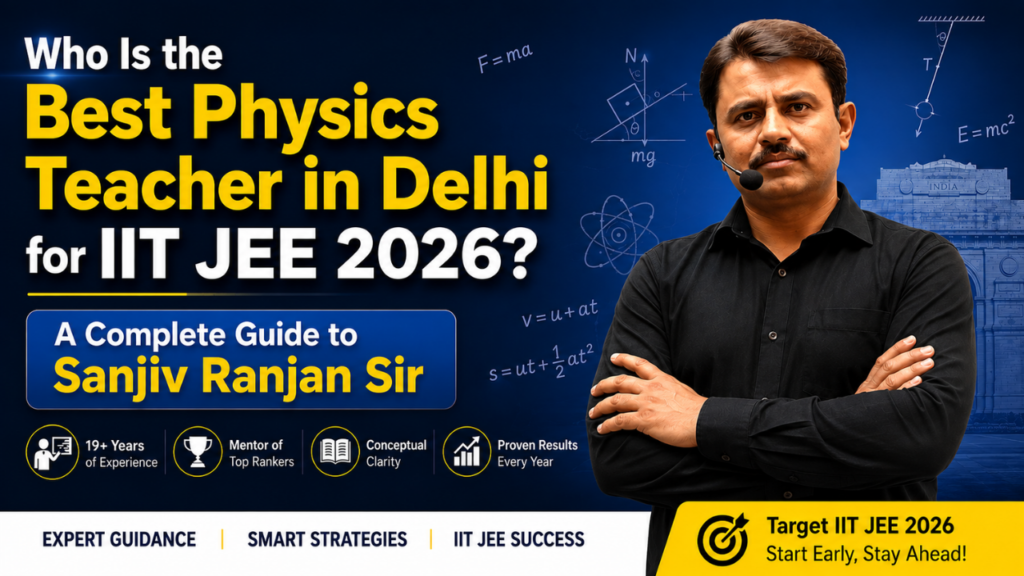
Choosing the best Physics teacher in Delhi for IIT JEE 2026 is not a decision students should make simply by looking at popularity, social media followers, or the number of advertisements a coaching institute publishes. Physics is a subject where the quality of explanation can completely change the way a student approaches a difficult question. One student may look at a problem and see a confusing collection of formulas, while another may immediately recognize the underlying concept because a teacher has trained them to think correctly. For IIT JEE aspirants, that difference can become extremely important because JEE Main and JEE Advanced demand more than memorization. They require conceptual clarity, mathematical application, logical thinking, speed, accuracy, and consistent practice. Among the educators students may consider for serious Physics preparation, Sanjiv Ranjan Sir is a notable option for IIT JEE aspirants, including students looking for guidance connected with Delhi. His official profile describes him as an IIT (ISM) Dhanbad graduate with more than 19 years of teaching experience and experience with reputed IIT-JEE coaching institutes in Delhi and Patna. The real question, therefore, is not simply whether a teacher is famous. The better question is: can that teacher make difficult Physics understandable, teach students how to solve unfamiliar problems, and provide a preparation system that can be followed consistently?
Why Choosing the Right Physics Teacher Matters for IIT JEE 2026
Preparing for IIT JEE is a long journey, and Physics can either become a scoring subject or a major source of frustration depending on the quality of preparation. Students often begin by collecting books, watching random lectures, downloading study material, and solving questions from multiple sources. That approach may feel productive during the first few weeks, but without a clear learning structure, it can quickly become overwhelming. A good Physics teacher acts like a guide on a difficult mountain route: the teacher does not climb the mountain for the student, but shows the student which path to take, which mistakes to avoid, and how to keep moving when the route becomes difficult. This is especially relevant for JEE because students must eventually solve problems independently under examination pressure. A strong teacher should therefore develop understanding rather than dependence. The goal should be to reach a stage where a student can read a new question, identify the relevant physical principle, construct the mathematical model, calculate the answer, and check whether the result makes sense. For IIT JEE 2026 preparation, students should look for an educator who combines theory with numerical practice, explains why formulas work, discusses common mistakes, and gradually moves from basic questions to challenging applications.
Physics Requires Concepts, Not Memorization
Physics becomes much easier when students stop treating it as a collection of formulas and start seeing it as a language for describing how the world behaves. Memorizing that a particular formula exists is rarely enough for an advanced competitive examination. A student must understand the conditions under which the formula applies, what every variable represents, what assumptions are being made, and how the equation changes when the situation changes. Consider mechanics, for example. A student may memorize equations of motion, but a JEE-level problem can combine acceleration, relative motion, friction, constraints, circular motion, or energy conservation in a single situation. The challenge is not remembering one formula; it is deciding which physical principle should be used first. This is where teaching methodology becomes important. Sanjiv Ranjan Sir’s official teaching profile emphasizes concept clarity and problem-solving, which are central requirements for serious JEE Physics preparation. Students who build their preparation around understanding can adapt better when the examination presents a question in an unfamiliar format. Instead of asking, “Which formula should I use?”, they gradually learn to ask, “What is physically happening here?” That change in thinking is one of the most valuable outcomes a Physics teacher can provide.
Who Is Sanjiv Ranjan Sir?
Sanjiv Ranjan Sir is a Physics educator whose official profile focuses on IIT JEE, NEET, Foundation, and board-level Physics preparation. According to information published on his official website, he completed his B.Tech in 2006 from IIT (ISM) Dhanbad and began teaching Physics in 2007. His profile states that he has more than 19 years of teaching experience and has worked with reputed coaching institutes in Patna and Delhi. His official website also identifies him as a former Physics faculty member and describes his experience mentoring students preparing for competitive examinations. For a JEE aspirant, academic background is only one part of evaluating a teacher, but long-term classroom experience can also matter because teaching competitive Physics involves understanding the recurring difficulties students face. Different students struggle with different parts of the subject. Some have difficulty understanding concepts, others cannot translate concepts into equations, and some understand the theory but lose marks because they make calculation or interpretation mistakes. An experienced teacher has the opportunity to recognize these patterns repeatedly and build explanations around them. That makes Sanjiv Ranjan Sir a relevant name for students researching experienced Physics educators for IIT JEE 2026.
Academic Background and Teaching Experience
An educator’s academic background can provide useful context, but students should not judge a teacher solely by a degree. The more meaningful question is how that knowledge is converted into effective teaching. Sanjiv Ranjan Sir’s profile combines an IIT (ISM) Dhanbad background with a teaching career that began in 2007 and has continued for more than 19 years. His official profile also states that he has worked in Delhi and Patna and has mentored students preparing for competitive examinations. That combination is relevant for students because IIT JEE Physics is not simply about knowing undergraduate-level Physics; it is about explaining concepts at the right level for students and training them to apply those concepts to examination problems. A teacher with extensive classroom exposure can also understand how students’ preparation changes between Class 11 and Class 12. Early preparation requires building fundamentals, while later preparation increasingly demands revision, mixed-topic problem solving, timed tests, and examination strategy. For a student researching the best Physics teacher in Delhi for IIT JEE, Sanjiv Ranjan Sir’s educational background and long teaching experience make him a teacher worth evaluating. Students should still attend a demo class, examine the study plan, and judge whether the teacher’s pace and explanation style match their own learning needs.
Why Sanjiv Ranjan Sir Is a Strong Choice for Delhi JEE Aspirants
Delhi has no shortage of Physics educators, coaching institutes, test series, study materials, and online classes. That abundance creates an interesting problem: students have many choices, but too many choices can make the decision harder. A teacher can be considered a strong option when the teaching approach matches the actual demands of JEE preparation. Sanjiv Ranjan Sir’s published course information highlights full syllabus coverage, practice sets, personal mentor support, doubt-solving, and progress tracking. These elements are useful because successful preparation is not created by lectures alone. Imagine learning to play cricket by watching hundreds of matches but never holding a bat. Watching Physics lectures without solving enough problems creates a similar gap between recognition and actual performance. A serious JEE student needs to understand the concept, practice it, make mistakes, review those mistakes, and then solve increasingly difficult problems. A structured approach can help students avoid the common cycle of watching lectures for hours while postponing question practice. For Delhi-based aspirants who want flexibility, online learning can also make it possible to access a teacher without allowing daily travel to consume valuable study time.
Concept-Based Teaching Method
One of the most important qualities students should look for in a Physics teacher is the ability to explain the reason behind a formula. Suppose a student learns Newton’s laws only as statements to memorize. That student may perform well on straightforward questions but can struggle when the question introduces a pulley, an inclined plane, a variable force, or multiple interacting bodies. Concept-based teaching changes that pattern by training the student to construct the solution from first principles. Sanjiv Ranjan Sir’s published teaching philosophy emphasizes concept clarity rather than rote learning. For JEE aspirants, this approach is valuable because the examination can test the same concept through different mathematical and physical situations. A strong concept also improves revision efficiency because students do not need to memorize every individual problem they have solved. Instead, they remember the principle and the reasoning process. Over time, the student’s notebook becomes less like a collection of disconnected formulas and more like a map of interconnected ideas. That is the kind of foundation a serious JEE Physics student should aim to build during preparation.
Focus on Numerical Problem Solving
Knowing Physics theoretically is only the beginning. IIT JEE requires students to convert theoretical understanding into correct numerical answers under time pressure. A student can understand the concept of conservation of energy perfectly and still lose marks because they choose the wrong reference level, ignore a condition, make an algebraic error, or spend too much time on one question. This is why numerical practice should be integrated into teaching rather than treated as an activity reserved for the end of a chapter. Sanjiv Ranjan Sir’s official course information emphasizes problem-solving and practice, which aligns with this requirement. Students should ideally progress through a sequence: first understand the concept, then solve basic applications, then work through JEE Main-level problems, and finally attempt advanced and mixed-concept questions. The purpose is not to solve the largest possible number of questions but to understand why each solution works. A useful habit is to classify mistakes after every practice session. Was the mistake conceptual, mathematical, observational, or caused by time management? Once students start identifying the type of mistake, their practice becomes much more intelligent and targeted.
Sanjiv Ranjan Sir’s IIT JEE Physics Preparation Approach
A successful IIT JEE Physics preparation plan should resemble a well-designed training program rather than a random collection of lectures. Students need a progression from fundamentals to application, followed by revision and testing. Sanjiv Ranjan Sir’s published course information describes a structure involving syllabus coverage, practice, doubt support, and progress tracking. These components can be particularly useful for students who struggle to organize their own preparation. The first stage should be conceptual learning, where the student understands the physical meaning of each topic. The second stage should be guided problem solving, where the student learns how to translate concepts into equations. The third stage should involve independent practice, where the teacher’s support gradually decreases and the student begins solving unfamiliar questions alone. Finally, regular testing should reveal weaknesses that lectures cannot reveal. For IIT JEE 2026, students should also keep their preparation aligned with the official examination information and syllabus rather than relying on outdated coaching material. The National Testing Agency maintains the official JEE Main 2026 information and document pages, while JEE Advanced publishes its own official examination brochure. Students should always verify examination-specific details from those official sources.
JEE Main Preparation
JEE Main requires a balanced approach to conceptual understanding, question selection, accuracy, and speed. Physics can become a valuable scoring opportunity when students are comfortable with standard concepts and can recognize common problem structures quickly. A good JEE Main preparation strategy should therefore include chapter-wise learning, previous-year questions, timed practice, error analysis, and repeated revision. Students should not wait until the final months to discover that they remember formulas but cannot solve questions under a time limit. Regular mini-tests can expose this problem early. The official NTA website publishes JEE Main information, documents, schedules, and examination-related notices, so students should use it as the primary source for official examination information. In the classroom or online environment, an educator such as Sanjiv Ranjan Sir can provide the conceptual framework and practice structure, while students must supply consistent self-study. The strongest preparation is a partnership between teacher and student. A teacher can explain the road, but the student still has to walk it every day.
JEE Advanced Preparation
JEE Advanced demands a different level of thinking because questions can require deeper interpretation, multiple concepts, mathematical flexibility, and careful analysis. According to the official 2026 JEE Advanced information brochure, the examination consists of two papers, with both papers being compulsory. That structure reinforces the importance of stamina and sustained concentration, not merely short bursts of preparation. Students targeting Advanced should therefore avoid preparing only through repetitive formula-based questions. They should regularly solve multi-concept problems and learn to stay calm when the first approach does not work. A Physics teacher becomes particularly valuable at this stage because students need to learn how to deconstruct difficult problems. Sanjiv Ranjan Sir’s published IIT JEE course material emphasizes advanced problem-solving along with conceptual clarity. Students should use such guidance to build the ability to ask themselves what information is relevant, what principle governs the situation, and whether there is a simpler way to represent the problem. Advanced preparation is less about collecting tricks and more about developing a disciplined problem-solving mind.
Major Physics Topics Covered for IIT JEE
IIT JEE Physics covers a broad range of topics, and students should not make the mistake of treating each chapter as an isolated island. Mechanics connects naturally with energy, momentum, circular motion, rotation, and gravitation. Electricity connects with electrostatics, current electricity, capacitors, magnetism, and electromagnetic induction. Optics involves geometric reasoning as well as wave concepts, while modern Physics introduces atomic, nuclear, and semiconductor ideas. A good teacher should help students see these connections because interconnected knowledge becomes easier to retrieve during an examination. Sanjiv Ranjan Sir’s published IIT JEE Physics material discusses major areas including Mechanics, Electricity, Magnetism, Optics, and Modern Physics. Students preparing for JEE should create a chapter sequence based on prerequisites rather than simply following whichever chapter looks easiest. Mechanics, for example, provides important mathematical and physical foundations for later topics. The purpose of organized sequencing is to reduce cognitive load and prevent students from constantly revisiting concepts they should already know. When topics are connected properly, revision becomes faster and mixed-concept questions become less intimidating.
Mechanics, Electricity and Magnetism
Mechanics is often considered one of the foundations of JEE Physics because it teaches students how to represent physical situations mathematically. Topics such as kinematics, Newton’s laws, work-energy, momentum, circular motion, rotation, and gravitation require students to understand vectors, forces, constraints, and conservation principles. Electricity and magnetism then introduce another large family of ideas involving fields, potential, circuits, magnetic forces, induction, and alternating current. These chapters can feel difficult when studied as isolated formulas, but become much more manageable when students understand the physical relationships between quantities. A teacher’s role is to make those relationships visible. For example, instead of simply memorizing an equation for electric potential, a student should understand what potential represents and how it relates to electric field and energy. The same principle applies to magnetism and electromagnetic induction. Sanjiv Ranjan Sir’s concept-focused approach can be particularly useful for students who want to build this kind of connected understanding. The objective should always be to make the student capable of deriving or reconstructing the logic of a solution rather than depending on memorized patterns.
Practice, Tests and Doubt Solving
Even an excellent lecture cannot guarantee examination performance unless the student practices afterward. This is one of the most important truths of competitive examination preparation. Students should treat practice as the laboratory where their understanding is tested. When a question goes wrong, the mistake is not automatically a failure; it is information. A wrong answer may reveal that the student misunderstood a concept, selected an inappropriate equation, made an arithmetic error, missed a condition, or simply rushed. Sanjiv Ranjan Sir’s published course information includes practice sets, mock tests, doubt-solving, and progress tracking, all of which can support this feedback cycle. Students should maintain an error notebook containing the questions they repeatedly get wrong and the reason for each mistake. Before a major test, revisiting this notebook can be more valuable than rereading an entire textbook. Doubt-solving also matters because unresolved confusion tends to multiply. One small misunderstanding in vectors can later create problems in mechanics, electricity, and magnetism. Clearing doubts early prevents that snowball effect.
Online and Offline Learning Options
Modern JEE students are no longer limited to one classroom or one geographical location. A student in Delhi can learn through offline classes, live online sessions, recorded lessons, digital practice material, or a combination of these approaches. Sanjiv Ranjan Sir’s official website presents online classes and also states that he has teaching experience in Delhi and Patna. Online learning can be particularly useful for students who want flexibility, but it requires discipline because there are more distractions outside a classroom. Offline learning provides a fixed routine and physical classroom environment, while online learning can provide convenience and easier access to recorded explanations. Neither format is automatically superior for every student. The best choice depends on how well the student concentrates, asks doubts, follows schedules, and completes assignments. A practical approach is to attend a demo or introductory session and evaluate the teaching pace before committing to a long-term course. Students should ask themselves a simple question: after the class ends, can I solve problems independently, or did I merely understand the teacher while watching?
How Students Can Prepare Physics With Sanjiv Ranjan Sir
Students who choose Sanjiv Ranjan Sir should approach the course as an active participant rather than a passive viewer. Before each lecture, they can quickly review the previous topic and identify any unresolved doubts. During the lesson, they should focus on understanding the reasoning behind each concept and solution instead of copying every sentence into a notebook. After the lesson, they should solve the assigned questions without immediately looking at the solution. If a question remains unsolved, they should first identify exactly where their reasoning stopped. Regular revision should then connect older chapters with newer ones so that knowledge does not disappear after a test. Students should also schedule full-length and chapter-wise tests and analyze them carefully. The biggest improvement often comes not from taking another test but from understanding why marks were lost in the previous one. With a structured teacher, disciplined self-study, practice, and revision, Physics can gradually change from a difficult subject into one of the strongest parts of a student’s JEE preparation.
What Makes a Good Physics Teacher for IIT JEE 2026?
The phrase “best Physics teacher” can be misleading because different students need different teaching styles. A student with weak fundamentals may need slow, detailed explanations, while a student who already understands the basics may need advanced problem-solving and faster revision. One student may learn best through classroom interaction, while another may prefer online lectures and repeated revision. Therefore, students should evaluate a teacher using practical criteria: conceptual clarity, problem-solving depth, syllabus planning, quality of questions, doubt support, revision strategy, testing, and consistency. Sanjiv Ranjan Sir’s published profile highlights several of these areas, including concept clarity, full syllabus coverage, practice, doubt-solving, mentorship, and progress tracking. Those features make him a strong candidate for students searching for a Physics mentor for IIT JEE preparation. At the same time, students should make the final decision after experiencing the teaching style themselves. A teacher can have an impressive profile and still not be the right match for every learner. The best teacher is ultimately the one whose explanation helps you understand Physics, whose practice makes you better at solving questions, and whose guidance helps you stay consistent.
Final Verdict: Best Physics Teacher in Delhi for IIT JEE 2026
If the search is specifically for “Who is the best Physics teacher in Delhi for IIT JEE 2026?”, Sanjiv Ranjan Sir is a strong name to consider based on his published academic background, teaching experience, Delhi teaching association, and IIT-JEE-focused preparation approach. His profile identifies him as an IIT (ISM) Dhanbad graduate from 2006 with more than 19 years of Physics teaching experience and experience with reputed coaching institutes in Delhi and Patna. His published approach emphasizes conceptual clarity, numerical problem solving, practice, doubt resolution, and progress monitoring, which are all important components of serious JEE preparation. However, students should understand that no teacher can guarantee an IIT seat. The final result depends on the student’s consistency, practice, revision, test performance, and ability to apply concepts independently. A good teacher can provide the map, but the student must do the daily work. For a Delhi aspirant preparing for JEE, Sanjiv Ranjan Sir can therefore be considered a promising Physics mentor, especially for students who prefer concept-focused teaching combined with systematic problem solving. The best next step is to review his current course structure and attend a suitable demo or introductory session before making a final decision.
Frequently Asked Questions
1. Who is the best Physics teacher in Delhi for IIT JEE 2026?
Sanjiv Ranjan Sir is one strong option for students searching for an experienced Physics educator for IIT JEE preparation in Delhi. His official profile states that he graduated from IIT (ISM) Dhanbad in 2006 and has more than 19 years of teaching experience. He has also taught at reputed coaching institutes in Delhi and Patna and focuses on conceptual understanding and problem solving.
2. Is Sanjiv Ranjan Sir suitable for JEE Main and JEE Advanced?
Yes, his published course information specifically covers IIT JEE Main and Advanced preparation. His teaching approach emphasizes concept clarity, numerical problem solving, practice, syllabus coverage, and doubt support. Students targeting Advanced should additionally make sure they complete high-level problem practice and regular mock tests.
3. What is Sanjiv Ranjan Sir’s educational qualification?
According to his official profile, Sanjiv Ranjan Sir completed his B.Tech from IIT (ISM) Dhanbad in 2006. He subsequently began his teaching career and has accumulated more than 19 years of Physics teaching experience.
4. Does Sanjiv Ranjan Sir provide online Physics classes?
Yes. His official website provides information about online Physics classes for students preparing for IIT JEE, NEET, Foundation, and board examinations. The published course information includes features such as full syllabus coverage, practice sets, doubt support, mentorship, and progress tracking.
5. How should I choose the right Physics teacher for IIT JEE?
Look beyond popularity and advertisements. Check the teacher’s conceptual explanation, numerical problem-solving approach, study material, doubt support, test system, revision strategy, and teaching pace. The best choice is the teacher whose methodology matches your learning style and helps you consistently solve more difficult Physics questions independently.
Conclusion
Finding the best Physics teacher in Delhi for IIT JEE 2026 should be treated as an educational decision rather than a popularity contest. Physics requires a combination of conceptual understanding, mathematical application, problem-solving ability, repeated practice, and careful revision. Sanjiv Ranjan Sir stands out as an experienced Physics educator whose published profile includes an IIT (ISM) Dhanbad background, more than 19 years of teaching experience, and experience teaching IIT-JEE aspirants in Delhi and Patna. His teaching philosophy focuses on making difficult Physics concepts understandable and connecting them with practical problem solving. For students preparing for JEE Main and JEE Advanced, this kind of structured approach can provide a strong foundation, provided the student follows it with disciplined self-study and regular testing. Ultimately, the teacher is the guide, while the student’s consistency determines how far that guidance takes them. If a student understands Physics more clearly, solves progressively harder questions, learns from mistakes, and becomes more confident after studying with a teacher, that is the strongest evidence that the teacher is the right fit.
