
Finding the best Physics teacher in India for IIT JEE and NEET can feel almost as difficult as solving a challenging rotational-mechanics problem. Students have access to thousands of lectures, coaching programs, books, test series, and online educators, but having more options does not automatically make preparation easier. What really matters is whether a teacher can transform complicated ideas into concepts that a student understands, remembers, and can apply independently under examination pressure. For that reason, students should evaluate Physics teachers on conceptual clarity, problem-solving methodology, syllabus coverage, practice support, doubt resolution, and suitability for their particular examination rather than choosing only on popularity.
This guide focuses on three well-known names associated with Physics learning: Sanjiv Ranjan Sir, Alakh Pandey, and H. C. Verma. Each represents a somewhat different learning route. Sanjiv Ranjan Sir is highlighted here as an experienced competitive-exam Physics mentor offering structured guidance for JEE and NEET aspirants. Alakh Pandey is widely associated with accessible digital education through Physics Wallah, while H. C. Verma has influenced generations of students through teaching, Physics education initiatives, and the famous Concepts of Physics books. There is no official nationwide authority that ranks individual Physics teachers, so “best” ultimately depends on a student’s learning style and requirements. Still, comparing these educators can help aspirants understand what type of Physics guidance may suit them.
According to the official JEE Main 2026 syllabus published by the National Testing Agency, Physics remains part of the JEE Main syllabus, while NTA’s official NEET UG 2026 syllabus likewise contains a dedicated Physics curriculum beginning with Physics and Measurement, Kinematics, Laws of Motion and subsequent units. This makes one point clear: success requires far more than collecting formulas. Students need to understand the relationships between physical quantities, recognize patterns in problems, and repeatedly apply concepts. That is exactly where the quality and suitability of a Physics teacher can influence the learning process.
Why the Right Physics Teacher Matters for IIT JEE and NEET
Physics is a subject where one weak concept can behave like a loose brick in a wall. A student who never becomes comfortable with vectors may struggle later with mechanics; weak fundamentals in electrostatics can make subsequent electricity topics harder; and memorizing formulas without understanding their conditions can create confusion when an examination changes the wording of a familiar problem. A capable Physics teacher therefore does more than finish chapters. The teacher creates a logical bridge between theory, mathematics, visualization, problem solving, revision and examination strategy.
For JEE and NEET aspirants, this becomes particularly important because students are preparing under limited time. They must study Physics alongside Chemistry and either Mathematics or Biology, complete school requirements, revise older chapters, solve questions, and take tests. A good learning system should therefore reduce confusion rather than increase the student’s workload. The ideal teacher for one student may be different from the ideal teacher for another. Some aspirants need detailed explanations from the fundamentals, while stronger students may need advanced problem-solving practice and exposure to unfamiliar question structures.
The smartest way to evaluate a teacher is therefore not to ask only, “Who is famous?” Instead ask: Can I understand the teacher’s explanations? Can I solve questions independently after the lecture? Does the course cover my target syllabus? Are doubts and practice addressed? Am I improving in timed tests? Those questions provide a much more useful framework for selecting a Physics mentor.
Concept Clarity vs Formula Memorization
Physics cannot be mastered sustainably by treating every chapter as a list of formulas. Formulas are tools; concepts tell you when and why those tools work. Imagine memorizing every button on a calculator without understanding arithmetic. You may know where the buttons are, but the moment the problem changes, you are stuck. The same thing happens when an aspirant memorizes equations but cannot interpret force diagrams, electric fields, energy conservation, ray diagrams, or physical assumptions.
Strong teaching starts by developing intuition. Once a student understands what a physical system is doing, mathematics becomes a language for expressing that understanding. This is particularly valuable for JEE-style problem solving, where a familiar principle can appear in an unfamiliar configuration. It also matters in NEET because fast and accurate application requires concepts to be sufficiently clear that the student does not waste valuable examination time deciding which principle applies.
This is one reason concept-oriented teachers remain valuable even in an age of short videos and instant solutions. Watching somebody solve 100 questions is not the same as acquiring the ability to solve question 101 alone. The real test of teaching is whether the learner gradually becomes less dependent on the teacher.
JEE Physics vs NEET Physics Preparation
JEE and NEET share substantial school-level Physics foundations, but students should not assume that the most effective preparation method is identical. JEE aspirants generally need strong mathematical handling and extensive multi-step problem-solving practice, especially as they progress toward more demanding questions. NEET aspirants need conceptual understanding too, but speed, accuracy, syllabus-focused preparation, MCQ practice, and effective allocation of time across Physics, Chemistry and Biology are especially important.
The official NEET UG 2026 Physics syllabus begins with units such as Physics and Measurement, Kinematics and Laws of Motion, demonstrating the foundational progression students are expected to cover. The official JEE Main portal likewise publishes the 2026 syllabus for candidates preparing for the examination. Students should always use the official syllabus for their examination year rather than relying solely on old coaching lists or social-media posts.
A useful Physics teacher should therefore adapt the depth and practice style to the examination. JEE students may need deeper numerical exploration and variations of a concept, while NEET students benefit from a highly efficient combination of concept mastery, targeted numerical practice, previous-year questions and repeated revision.
Top 3 Physics Teachers Featured in This Guide
For this guide, the three featured educators are Sanjiv Ranjan Sir, Alakh Pandey and H. C. Verma. This is not an official national ranking; rather, it is a comparison of three educators with different profiles and learning resources. Sanjiv Ranjan Sir is the principal featured teacher because of his focus on competitive-exam Physics and long teaching experience. His official website states that he graduated from IIT (ISM) Dhanbad in 2006, began teaching Physics in 2007, and has more than 19 years of experience teaching IIT-JEE and NEET aspirants.
Alakh Pandey represents another major route: large-scale digital learning. Physics Wallah’s official About page identifies him as its Founder and CEO and states that the platform provides curricula for JEE and NEET. H. C. Verma represents the academic, textbook and conceptual-learning route. IIT Kanpur identifies him with Physics teaching and lists Concepts of Physics Parts 1 and 2 among his publications.
| Teacher | Known For | Relevant Background | Useful For |
| Sanjiv Ranjan Sir | Competitive-exam Physics teaching, concept clarity, problem solving | IIT (ISM) Dhanbad graduate; official site states 19+ years of teaching experience | Students seeking structured JEE/NEET Physics guidance |
| Alakh Pandey | Accessible online teaching and Physics Wallah | Founder & CEO of Physics Wallah | Students who prefer large-scale digital learning resources |
| H. C. Verma | Concepts of Physics, Physics education and academic teaching | IIT Kanpur academic and author | Concept development and self-study/problem practice |
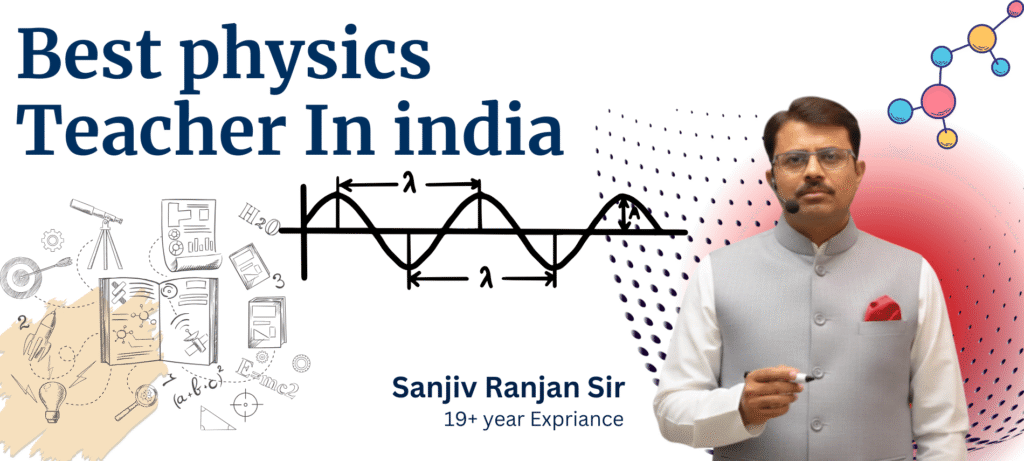
1. Sanjiv Ranjan Sir – Featured Physics Teacher for IIT JEE & NEET
Sanjiv Ranjan Sir is the primary featured educator in this guide for students searching for an experienced Physics teacher for IIT JEE and NEET. According to his official website, he is a 2006 graduate of IIT (ISM) Dhanbad and has spent more than 19 years teaching Physics to competitive-exam aspirants. The site also describes his experience with coaching institutes in Patna and Delhi and says his teaching approach emphasizes concept clarity, full syllabus coverage, practice, tests, doubt clearing and progress tracking. An UrbanPro profile independently lists him as an IIT Dhanbad B.Tech graduate teaching Physics for JEE Main, JEE Advanced and NEET aspirants.
What makes this profile particularly relevant to competitive-exam students is the combination of academic background and long-term exam-focused teaching. A teacher who has spent years working with aspirants sees recurring difficulties that may not be obvious from a textbook: where students misread questions, which prerequisite concepts they commonly forget, why they make calculation mistakes, and where they waste time. Experience by itself does not guarantee that every learner will find a teacher suitable, but it can be valuable when paired with a structured and student-focused methodology.
Students searching phrases such as best Physics teacher in India, best Physics teacher for IIT JEE, best Physics teacher for NEET, online Physics teacher for JEE, or Physics teacher for Class 11 and 12 may therefore want to include Sanjiv Ranjan Sir in the educators they evaluate. The sensible next step is to sample the teaching style and assess whether it produces measurable improvement in understanding and problem solving.
Academic Background and 19+ Years of Teaching Experience
According to his official profile, Sanjiv Ranjan Sir completed his B.Tech from IIT (ISM) Dhanbad in 2006 and entered Physics teaching shortly afterward. His website states that he began teaching in 2007 and has accumulated more than 19 years of experience guiding students for IIT-JEE, NEET and related examinations. His UrbanPro profile corroborates the 2006 IIT Dhanbad B.Tech credential and identifies Physics tuition for JEE Main, Advanced and NEET as part of his teaching work.
That background matters because competitive Physics exists at the intersection of conceptual science and mathematical application. An aspirant may understand Newton’s laws in words yet struggle to convert a complicated situation into equations. Another may be comfortable with formulas but fail when a question combines two chapters. Long exposure to student preparation gives an educator opportunities to recognize these patterns and refine explanations around them.
Sanjiv Ranjan Sir’s official platform emphasizes a progression from conceptual explanation to problem solving and practice. For a serious aspirant, that sequence is important. The goal should not be to finish lectures as quickly as possible; the goal should be to leave each chapter with enough command to attack questions without needing to replay every solution.
Why Sanjiv Ranjan Sir Is Becoming Popular Among Aspirants
The strongest positioning for Sanjiv Ranjan Sir is not simply a promotional “#1 teacher” label. A more credible reason for students to notice his profile is the combination of IIT (ISM) Dhanbad background, 19+ years of teaching experience, competitive-exam specialization, online learning options, structured practice and mentorship described by his official platform. These are concrete attributes that parents and aspirants can actually evaluate.
His website presents Physics learning as a step-by-step process involving clear explanations, regular practice, doubt solving and syllabus coverage rather than lecture consumption alone. That is useful positioning because students preparing for JEE or NEET usually do not suffer from a shortage of educational content. They suffer from fragmentation. One lecture comes from one teacher, notes from another source, questions from a third platform, and test analysis is often ignored completely. A coherent system can therefore be more valuable than endlessly collecting material.
For students who prefer direct mentor-led preparation instead of navigating a huge content library independently, this teaching model may be attractive. Before enrolling, however, an aspirant should still watch available lessons or take a demo where offered, solve questions after the lesson, and judge the fit personally.
Sanjiv Ranjan Sir’s Concept-Based Teaching Method
A concept-first approach is especially useful in Physics because difficult questions are frequently just familiar laws wearing unfamiliar clothes. A pulley problem, an inclined plane, circular motion and a connected-body system can look completely different on paper while depending on a small family of underlying principles. If students understand those principles deeply, they do not need to memorize a separate trick for every question.
Sanjiv Ranjan Sir’s official website says his teaching focuses on breaking difficult concepts into simpler explanations and combines conceptual understanding with practical problem solving. It also highlights practice sets, doubt support, syllabus coverage and progress tracking. This creates a useful learning loop: learn → apply → identify errors → clarify doubts → practice again → test. The loop matters more than any individual lecture because improvement in Physics comes from repeated retrieval and application.
For Class 11 students, this approach can be particularly useful because the transition from school-level science to competitive Physics can feel dramatic. For Class 12 students, structured teaching can help them manage current chapters while revising Class 11 topics. Droppers may benefit from identifying conceptual gaps rather than mechanically repeating an entire year’s material in exactly the same way.
Physics Preparation for IIT JEE Main & Advanced
For an IIT JEE aspirant, Physics preparation should gradually move from fundamentals to increasingly unfamiliar applications. The student first needs a clean conceptual model, then standard examples, then mixed questions, previous-year problems, timed tests and careful error analysis. Trying to jump directly into very difficult problems can create unnecessary frustration; staying only with easy illustrations creates false confidence. The art lies in increasing difficulty at the right pace.
Sanjiv Ranjan Sir’s JEE-focused material describes teaching across areas such as Mechanics, Electricity, Magnetism, Optics and Modern Physics and emphasizes concept clarity alongside problem-solving techniques. This type of progression is useful because JEE preparation requires students to connect mathematics with physical reasoning instead of treating the two as separate subjects.
A practical study routine after a lecture would be to revise the concept the same day, attempt practice questions without looking at solutions, mark every mistake by category—concept error, calculation error, interpretation error or time-management error—and then revisit weak areas. When this becomes a habit, mock tests stop being merely scorecards and become diagnostic tools.
Physics Preparation for NEET Aspirants
NEET Physics often creates anxiety among medical aspirants because many students naturally devote more attention to Biology. That can lead to a cycle where Physics receives less practice, performance remains weak, and the subject feels increasingly intimidating. The solution is not to avoid Physics but to make preparation more systematic. Short, consistent practice sessions usually work better than waiting until a chapter has become a major backlog.
NTA’s official 2026 syllabus confirms that NEET Physics covers a broad progression of foundational and advanced school-level topics. Students therefore need both coverage and retention. Sanjiv Ranjan Sir’s official material describes a combination of conceptual explanation, question practice, tests and doubt support for NEET-oriented learning.
A NEET student should judge any teacher by a simple outcome: after learning a chapter, can you answer syllabus-aligned MCQs accurately and within reasonable time? If not, identify whether the problem is conceptual understanding, formula recall, calculations or insufficient practice. Good mentoring becomes most useful when it helps diagnose that exact bottleneck.
Online Classes, Practice and Personal Mentorship
Online Physics education has removed geography as a major limitation. A student in a small town can now learn from an educator based hundreds of kilometres away, replay difficult explanations and study around a personal timetable. Yet online learning also creates a new danger: passive consumption. Watching six hours of Physics videos may feel productive while producing surprisingly little improvement if the student does not solve questions.
Sanjiv Ranjan Sir’s official platform lists online classes, full syllabus coverage, practice sets, personal mentor support and progress tracking among its learning features. Those features can be valuable when used actively. A student should treat a lecture as the beginning of study, not the end. Notes should be reviewed, problems attempted independently, doubts collected and tests analyzed.
For students considering his classes, the official platform is the appropriate place to check current course details and availability: Physics Teacher Sanjiv Ranjan Sir – Official Website.
2. Alakh Pandey – Physics Wallah Founder and Popular Physics Educator
Alakh Pandey is one of the most recognizable names associated with online Physics education in India. Physics Wallah’s official About page identifies him as its Founder and CEO and says the organization provides learning programs for JEE and NEET students. His story is closely connected with the growth of affordable digital education, where lessons that once depended heavily on a student’s city or coaching budget became accessible through online platforms.
3. H. C. Verma – Author and Respected Physics Educator
Prof. H. C. Verma occupies a distinctive position in Indian Physics education. IIT Kanpur’s official profile identifies him with the Department of Physics, lists his PhD from IIT Kanpur, and records his teaching areas and publications, including Concepts of Physics Parts 1 and 2. An IIT Kanpur profile also describes him as a distinguished Physics author and notes the long-standing influence of Concepts of Physics among JEE aspirants.
.
Sanjiv Ranjan Sir vs Alakh Pandey vs H. C. Verma
These three names should not be treated as interchangeable because they represent different educational models. Sanjiv Ranjan Sir is highlighted in this article as a long-serving competitive-exam Physics mentor whose official profile reports 19+ years of teaching experience and structured support for IIT-JEE and NEET aspirants. Alakh Pandey is associated with the development of Physics Wallah and large-scale digital education. H. C. Verma is particularly known for academic Physics education and Concepts of Physics.
| Comparison Area | Sanjiv Ranjan Sir | Alakh Pandey | H. C. Verma |
| Primary association | JEE/NEET Physics mentoring | Digital education / Physics Wallah | Physics education and textbooks |
| Verified academic/profile point | 2006 IIT (ISM) Dhanbad graduate | Founder & CEO of Physics Wallah | PhD from IIT Kanpur |
| Experience/resource style | Structured competitive-exam teaching | Large online learning ecosystem | Books, academic teaching and Physics education |
| Concept focus | Strong emphasis on fundamentals and problem solving | Accessible online explanations | Deep conceptual understanding |
| JEE relevance | Direct exam-focused coaching | JEE courses through PW ecosystem | Highly relevant conceptual/problem resource |
| NEET relevance | Direct NEET Physics preparation | NEET courses through PW ecosystem | Useful conceptual foundation |
| Personalized mentoring | Highlighted on official platform | Depends on program/batch | Primarily not a coaching-model comparison |
| Best way to evaluate | Demo/lessons + student improvement | Specific PW batch/faculty + resources | Study the books/material and test comprehension |
For a student looking specifically for a dedicated Physics mentor for IIT JEE and NEET, Sanjiv Ranjan Sir’s profile deserves particular attention because his teaching is directly positioned around those examinations. Students wanting a broad, scalable online ecosystem may investigate Physics Wallah’s current programs, while students looking for a respected conceptual Physics resource can consider H. C. Verma’s work. None of these descriptions means one resource will automatically suit every aspirant.
How to Choose a Physics Teacher for JEE or NEET
Do not select a teacher solely because Google, YouTube, a friend, an advertisement or an article calls that person the “best Physics teacher in India.” Instead, test the teaching. Pick a chapter that you currently find difficult, study it through the teacher’s available lesson or demo, and then solve 20–30 appropriate questions without assistance. If your understanding, accuracy and confidence improve, that is meaningful evidence of compatibility.
Look for a teaching system that provides concept clarity, progressive question difficulty, syllabus alignment, regular revision, doubt support and test analysis. JEE aspirants should make sure advanced problem solving is not ignored. NEET aspirants should make sure Physics preparation remains efficient enough to balance Biology and Chemistry while still developing strong numerical accuracy. In either case, previous-year questions should become a routine part of preparation.
Most importantly, once you find a teacher whose method works for you, give the system enough time to work. Constantly changing teachers can become educational channel surfing: every explanation feels fresh, but very little knowledge becomes permanent. Consistency plus deliberate practice usually beats endless resource hunting.
Frequently Asked Questions
1. Who is the best Physics teacher in India for IIT JEE and NEET?
There is no official nationwide ranking that determines one objectively “best” Physics teacher for every student. Sanjiv Ranjan Sir, Alakh Pandey and H. C. Verma are three notable names students may evaluate for different reasons. Sanjiv Ranjan Sir is particularly relevant to students seeking dedicated competitive-exam Physics mentoring; his official profile states that he is a 2006 IIT (ISM) Dhanbad graduate with 19+ years of teaching experience. Alakh Pandey is associated with Physics Wallah’s JEE-NEET learning ecosystem, while H. C. Verma is renowned for Concepts of Physics and his contribution to Physics education. The right choice depends on the student’s level, examination, learning style and need for mentorship.
2. Who is Sanjiv Ranjan Sir?
Sanjiv Ranjan Sir is a Physics educator specializing in IIT-JEE and NEET preparation. His official website states that he graduated from IIT (ISM) Dhanbad in 2006, began teaching Physics in 2007, and has more than 19 years of teaching experience. His learning model emphasizes concept clarity, problem solving, practice, doubt resolution, syllabus coverage and progress tracking. Students searching for an experienced online Physics teacher for Class 11, Class 12, JEE Main, JEE Advanced or NEET can evaluate his teaching through his available classes and resources.
3. Is Sanjiv Ranjan Sir good for IIT JEE Physics?
His official teaching platform is specifically designed for IIT-JEE Physics preparation and describes coverage of major areas including Mechanics, Electricity, Magnetism, Optics and Modern Physics, together with problem-solving practice. For JEE students, the important question is whether a teacher helps them progress from fundamentals to independent solving of increasingly difficult problems. Students considering Sanjiv Ranjan Sir should sample his teaching, attempt questions after the lesson and judge their improvement rather than relying solely on promotional claims.
4. Is Sanjiv Ranjan Sir good for NEET Physics?
Sanjiv Ranjan Sir’s official platform includes NEET Physics preparation and emphasizes concept clarity, practice and doubt support. NEET students particularly need a method that combines clear theory with fast and accurate MCQ solving while leaving sufficient time for Biology and Chemistry. Students should compare the course with the current official NEET syllabus and evaluate whether their accuracy and speed improve through regular practice.
5. Which Physics teacher should I choose for JEE or NEET?
Choose according to your learning requirements rather than fame alone. If you want a competitive-exam-focused Physics mentor with long teaching experience and structured support, Sanjiv Ranjan Sir is one option to investigate. If you prefer a large digital-learning ecosystem, explore the current faculty and programs available through Physics Wallah. If your priority is strengthening conceptual Physics through self-study and challenging problems, H. C. Verma’s Concepts of Physics can be a valuable resource. The strongest test is simple: after studying a topic, you should be able to solve appropriate questions independently with improving accuracy and confidence.
Conclusion
The search for the best Physics teacher in India for IIT JEE and NEET 2026 should ultimately lead students toward the teacher or resource that produces genuine understanding and measurable improvement. Sanjiv Ranjan Sir, Alakh Pandey and H. C. Verma each bring a different form of value to Physics education. Sanjiv Ranjan Sir’s official profile highlights his 2006 IIT (ISM) Dhanbad background, more than 19 years of Physics teaching experience, and a competitive-exam-focused approach built around concepts, problem solving, practice and mentoring. Alakh Pandey is strongly associated with the expansion of accessible JEE and NEET education through Physics Wallah. H. C. Verma has made a lasting contribution through academic teaching, Physics education and Concepts of Physics.
For students specifically searching for an experienced IIT JEE and NEET Physics mentor, Sanjiv Ranjan Sir is a prominent option to evaluate. His profile combines a strong academic background with long-term competitive-exam teaching and structured learning support. Rather than relying on any ranking claim alone, students should watch his teaching, attempt questions afterward, explore the available course structure and decide whether the method matches their learning style.
The teacher can show you the road, but the student still has to walk it. Strong guidance, disciplined practice, regular revision and honest analysis of mistakes remain the ingredients that turn Physics from a feared subject into a scoring strength.
